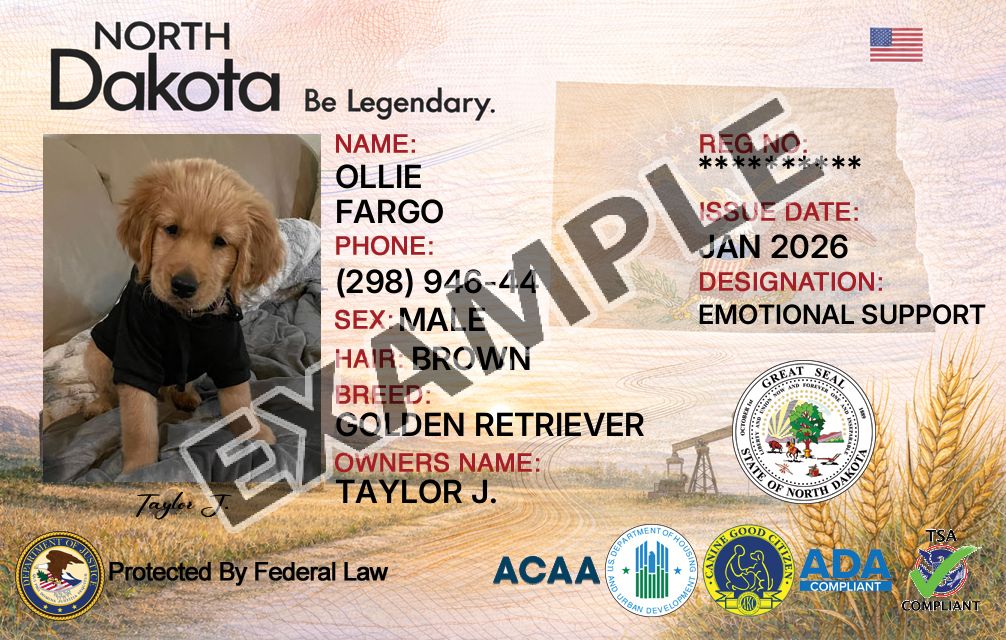
Registering a Dog in McHenry County, North Dakota (Including Service Dogs & Emotional Support Animals)
If you’re asking where do I register my dog in McHenry County, North Dakota for my service dog or emotional support dog, the key thing to know is that dog licensing is usually handled locally (often by the city you live in, and sometimes in coordination with county offices). A dog license in McHenry County, North Dakota is generally about identification, vaccination compliance, and local animal ordinances—not about “certifying” a service dog or emotional support animal.
Where to Register or License Your Dog in McHenry County, North Dakota
Because licensing and enforcement are often handled at the city or county level, the offices below are practical starting points in McHenry County. These examples are official public offices that residents commonly contact for local government services, animal ordinance questions, or rabies-related guidance. Ask whether your specific address (inside or outside city limits) has a licensing requirement and where payments/applications are processed.
McHenry County Auditor (County Courthouse)
Address
407 Main St S, Room 201
Towner, ND 58788
Contact
Phone: (701) 537-5724
Email: dcarpenter@nd.gov
Office hours
Not listed (call to confirm).
Use this office if you need the correct local point of contact, especially if you live outside city limits or you’re unsure which local jurisdiction applies.
McHenry County Sheriff (General Animal Ordinance / Enforcement Questions)
Address
Not listed in available official directory sources for this page (call to confirm location).
Contact
Phone: (701) 567-2530
Office hours
Not listed (call to confirm).
If you’re looking for “animal control dog license McHenry County, North Dakota” guidance and your area does not have a dedicated animal control office, the sheriff’s office is often the best starting point for enforcement and “who handles this locally” questions.
McHenry County Public Health (First District Health Unit – McHenry County Office)
Address
112 Main Street South
Towner, ND 58788
Mailing: PO Box 517, Towner, ND 58788
Contact
Phone: (701) 537-5732
Fax: (701) 537-0804
Office hours
Monday–Friday: 8:00 AM–12:00 PM and 1:00 PM–4:30 PM
Public health can be a helpful resource for rabies prevention information and local public health guidance if you’re dealing with a bite, exposure, or vaccination documentation questions.
North Dakota Court System – McHenry County Courthouse (General Courthouse Contact)
Address
407 S Main St
Towner, ND 58788
Mailing: 407 Main St S, Room 203, Towner, ND 58788
Contact
Phone: (701) 537-5729
Fax: (701) 537-0555
Office hours
8:00 AM–4:30 PM (Closed 12:00 PM–1:00 PM)
This general courthouse contact can help route you to the correct county office if you’re unsure where to start. For licensing itself, you’ll usually be directed to a city office or another local authority rather than the court.
Quick tip: start with your jurisdiction
When asking where to register a dog in McHenry County, North Dakota, the most important detail is whether your home is inside a city’s limits. Many North Dakota communities set licensing rules at the city level. If you live in a city, ask the city office about pet licensing. If you live in a rural area, ask the county auditor or sheriff which local ordinance applies.
Overview of Dog Licensing in McHenry County, North Dakota
What a dog license is (and what it is not)
A local dog license is typically a record that links a dog to an owner and address, often paired with a tag. Communities use licensing to support animal ordinance enforcement, help return lost pets, and encourage rabies vaccination compliance. If your area requires a dog license in McHenry County, North Dakota, you’ll usually need to renew it on a schedule set by the local government.
A dog license is not a service dog “certification” and it does not convert a pet into a service animal or emotional support animal. Service dog status is based on training and disability-related work/tasks (under federal law), and ESA status is related to housing (and sometimes air travel policies), not local licensing.
Rabies vaccination is the common requirement behind licensing
While rules can vary by city, rabies vaccination proof is a common prerequisite for local licensing and for compliance if a dog bites someone or is found running at large. Keeping a current rabies certificate (and knowing your veterinarian’s contact information) helps you respond quickly if an office asks for documentation.
How Dog Licensing Works Locally in McHenry County, North Dakota
Step 1: Confirm who issues licenses for your address
In many parts of North Dakota, pet licensing is managed by the city you live in, not by a single countywide animal services department. That’s why the first call is usually to your city office (if you live within a city), or to a county contact who can confirm the correct jurisdiction. If you’re searching for an animal control dog license McHenry County, North Dakota office and can’t find a dedicated “animal control” department, ask the sheriff’s office or county auditor who handles animal ordinance enforcement and licensing coordination in your area.
Step 2: Gather documents and apply (or renew)
Most local licensing processes are straightforward: you provide owner identification details, your address, and vaccination information. Some places also track spay/neuter status and may have different fees depending on local ordinances. If you’ve recently moved, you may need to update your address so your dog’s license record matches where the dog resides.
Step 3: Keep records accessible
Keep a copy of your rabies vaccination certificate and any local license receipt in a place you can access quickly. This helps if your dog is lost and recovered, if you need to prove vaccination after a bite/exposure incident, or if a local ordinance requires proof during renewal.
If you’re licensing a service dog or ESA
If your dog is a service dog or emotional support animal, you may still be expected to follow the same local dog licensing and vaccination rules as any other dog. Some jurisdictions may waive certain pet fees for service animals, while others treat licensing as a neutral public-safety requirement. Ask the local office what their policy is, but avoid third-party “registrations” that claim to be official.
Service Dog Laws in McHenry County, North Dakota
What makes a dog a service dog
A service dog is generally a dog that is individually trained to do work or perform tasks for a person with a disability. The tasks must be directly related to the person’s disability (for example, guiding, alerting, retrieving items, interrupting harmful behaviors, or providing mobility support). This legal status is separate from whether you have a local pet license.
No “official registration” is required for legal status
Many people searching “where do I register my dog in McHenry County, North Dakota for my service dog” are really looking for a government registry. In practice, local licensing is about public health and ordinances (like rabies compliance, tags, and nuisance rules), not a service-dog registry. Be cautious of anyone selling “official” credentials or claiming you must buy a certificate to be legal.
Public access basics and local compliance
Even when a dog is a legitimate service dog, owners/handlers generally must still comply with neutral local rules that apply to all dogs (such as vaccination requirements and leash/control rules where applicable). If you have a question about a local ordinance or a complaint process, start with the appropriate local office listed above.
Emotional Support Animal Rules in McHenry County, North Dakota
What an emotional support animal is
An emotional support animal (ESA) is an animal that provides comfort to a person and may be recognized for certain housing-related accommodations. ESAs are not the same as service dogs because they are not required to be trained to perform specific disability-related tasks. Because of that difference, ESAs typically do not have the same public access rights as service dogs.
Licensing and rabies rules still apply
If your dog is an ESA, it’s still a dog living in a local jurisdiction—so local requirements like vaccination documentation and a local license (if required where you live) can still apply. If you’re trying to figure out where to register a dog in McHenry County, North Dakota for ESA purposes, your “registration” is usually simply the local dog license plus your housing documentation (when needed).
Avoid confusing ESA letters with “pet licensing”
ESA documentation (when legitimate and needed) is generally used for housing accommodation requests. A dog license is a local record used for public safety, identification, and ordinance compliance. Keep these two tracks separate: one is local government administration, the other is accommodation documentation.
Frequently Asked Questions
Possibly. Service dog status and local licensing are different things. Many places still require compliance with neutral public-safety rules (like rabies vaccination proof and local tags), even if a dog is a service dog. Call the local office that covers your address and ask what their current licensing policy is.
Local government offices typically handle pet licensing and ordinance enforcement, not a service-dog registry. If you’re looking for where to “register” a service dog, what you usually need is a standard local license (if required where you live) plus compliance with vaccination rules. For service dog legal status, the focus is on training and disability-related tasks rather than a county registration.
Start with a county contact (like the county auditor) or the sheriff’s office to confirm which local rules apply and where licensing is handled for rural addresses. This is often the fastest way to get a clear answer to “where to register a dog in McHenry County, North Dakota” when you’re not sure of jurisdiction.
Typically, a rabies certificate or receipt from a licensed veterinarian showing the vaccination date and duration is used as proof. If you’re applying for or renewing a local license, ask the licensing office what they accept and whether they need a copy on file.
The terms describe different legal frameworks. A service dog is trained to perform disability-related tasks. An ESA is generally about comfort and housing accommodations. The same dog may provide comfort, but service dog status depends on task training. For local licensing, the office usually treats the dog the same for vaccination and identification purposes.
Disclaimer
Licensing requirements and office locations may change. Residents should verify details with their local animal services office within McHenry County, North Dakota.